Jain Cosmology Upper world | Urdhva Loka
The Upper World is the realm of liberated souls (Siddhas) and heavenly beings (Devas). It is shaped like a drum (mridanga).
The Ultimate Summit: Siddhashilā
At the very top of the Urdhva Loka, beyond the Kalpātīta heavens, lies the permanent abode of liberated souls.
Characteristics of Siddhashilā:
- Location: Situated at the crest of the universe (Loka-ākāsha), right before the boundary of non-universe (Aloka-ākāsha).
- Physical Form: A crescent-shaped, shining white canopy spanning 4.5 million Yojanas (exactly matching the size of the Manushya Kshetra / human region below).
- Inhabitants: The Siddhas—souls entirely free from the 8 types of Karma. They exist in a state of infinite knowledge (Ananta Jnana), infinite perception, and eternal bliss.
- Limitation: Souls cannot move past this boundary into Aloka because Dharmastikaya (the medium of motion) does not exist beyond the Loka.
Devlok
Classification 1: By Spiritual/Hierarchical Status
Heavenly beings are classified based on their spiritual progression, lifespan, and systemic hierarchy.
1. Kalpabhavana Devas (Inhabiting the Kalpas)
These gods live in structured, ritualistic societies with a defined hierarchy (containing Kings/Indras, ministers, armies, and subjects).
- Structure: Consists of 16 Kalpas (Heavens) in Digambara tradition / 12 Kalpas in Shvetambara tradition, arranged in pairs or tiers.
2. Kalpātīta Devas (Beyond the Kalpas)
These gods are spiritually advanced, physically detached, and do not have a social hierarchy (there are no Indras or servants; all are equal, like kings).
-
Graiveyakas: 9 heavens located above the 16th Kalpa, situated like a necklace around the neck of the universe.
-
Anuttaras: 5 supreme heavens (Vijaya, Vaijayanta, Jayanta, Aparajita, and Sarvarthasiddhi). Inhabitants here are Ahamindra (self-rulers) and are bound to achieve Moksha in 1 or 2 births.
Classification 2: By Geography (The 16/12 Kalpas)
The heavens are stacked vertically above Mount Meru. Here is the canonical breakdown of the Kalpas:
| Tier / Pair | Digambara Tradition (16 Kalpas) | Shvetambara Tradition (12 Kalpas) |
|---|---|---|
| 1st Pair | 1. Saudharma & 2. Ishana | 1. Saudharma & 2. Ishana |
| 2nd Pair | 3. Sanatkumara & 4. Mahendra | 3. Sanatkumara & 4. Mahendra |
| 3rd Pair | 5. Brahma & 6. Brahmottara | 5. Brahma |
| 4th Pair | 7. Lantava & 8. Kapishta | 6. Lantava |
| 5th Pair | 9. Shukra & 10. Mahashukra | 7. Shukra |
| 6th Pair | 11. Shatara & 12. Sahasrara | 8. Sahasrara |
| 7th Pair | 13. Anat & 14. Pranata | 9. Anata & 10. Pranata |
| 8th Pair | 15. Arana & 16. Achyuta | 11. Arana & 12. Achyuta |
Jain Cosmology Middle World / Madhyaloka
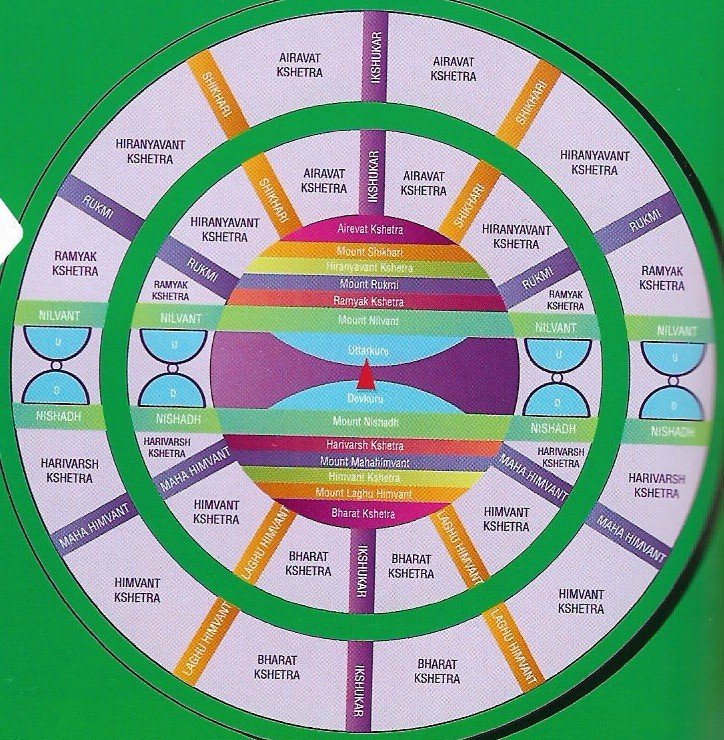
Refer to the video in link
(Trigger - Tirthankar charitra ep1)
Classification 1: By Human-Inhabitable Regions (Manuṣya Kṣetra)
There are 101 Manuṣya Kṣetras.
1. Karmabhūmi
15 Regions where:
- Tirthankaras appear.
- Asceticism is possible.
- Moksha-mārga can be practiced.
- Humans earn karma through effort in some areas and aras
So there are times in Bharata and Airavat karma bhumi when there is no dharm, look up Kaal Chakra and Time units#Six Aras (Epochs) in Each Half-Cycle
Bharata Kshetra
- 5 Regions across Dwips
- Subject to Avasarpiṇī and Utsarpiṇī.
- We live in one of these.
Airavat Kshetra
- 5 Regions across Dwips
- Similar to Bharata.
- Subject to Avasarpiṇī and Utsarpiṇī.
Mahavideha Kshetra
- 5 Regions across Dwips
- Perpetually suitable for Dharma.
- Tirthankaras are always present somewhere.
- Not subject to the same Kaal Chakra and Time units#Six Aras (Epochs) in Each Half-Cycle fluctuations as Bharata and Airāvata.
Total = 15
2. Bhogabhumi (Akarmabhumi)
30 Regions where:
- Life is effortless.
- Food and necessities arise naturally.
- No severe austerities.
- No Tirthankaras appear.
- Moksha is not attained there.
Types occurring throughout the cosmos
| Region Type | Count per Set | |
|---|---|---|
| Haimavata | 2 | |
| Hari | 2 | |
| Ramyaka | 2 | |
| Hairaṇyavata | 2 | |
| Devakuru | 1 | one each in every mahavidey kshetra |
| Uttarakuru | 1 | one each in every mahavidey kshetra |
Each cosmological arrangement contains 10 such regions.
Across the three relevant continental systems:
10 × 3 = 30 Bhogabhūmis
- Here Yugaliks reside
UttarKuru and Devakuru
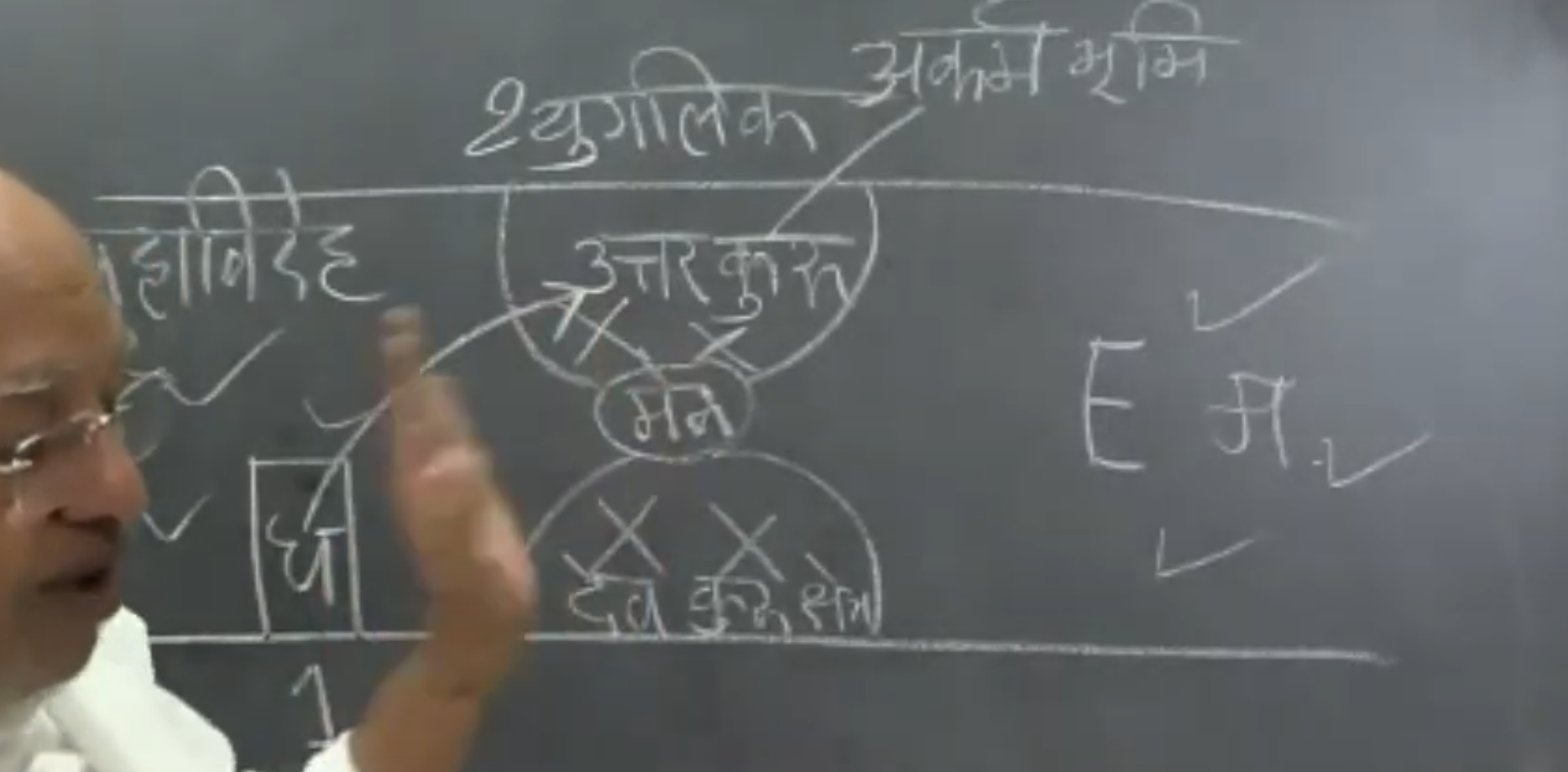
source - https://youtu.be/ZreyoW3yXgs?list=PLi3vTa_oBFFdA7QVTJQIq6nqCcGH-z9l7&t=1837
3. Antaradvīpas
Smaller islands between continents and oceans.
56 Regions Characteristics:
- Human inhabitants exist.
- Distinct physical characteristics.
- Separate from both Karmabhūmi and Bhogabhūmi classifications.
Total = 56
Total Human Regions
| Category | Count |
|---|---|
| Karmabhūmi | 15 |
| Bhogabhūmi | 30 |
| Antaradvīpa | 56 |
| Total | 101 |
Classification 2: By Geography (Dvīpa-Samudra Structure)
This is a different classification from the one above.
The Middle World consists of alternating continents and oceans arranged concentrically around Mount Meru.
Central Region
Jambūdvīpa
Contains seven major regions:
- Bharata
- Haimavata
- Hari
- Videha
- Ramyaka
- Hairaṇyavata
- Airāvata
These are separated by mountain ranges.
The central Videha region contains the Mahāvideha areas.
Beyond Jambūdvīpa
Alternating rings continue outward:
- Jambūdvīpa
- Lavaṇa Samudra
- Dhātakīkhaṇḍa
- Kālodadhi
- Puṣkaradvīpa
- Puṣkaroda Ocean
- Further concentric rings ...
The pattern continues outward for enormous distances.
mahavidaeh spreads across JambuDwip (1L yojan width) 2 in Dhātakīkhaṇḍa(4 L yojan) and Puṣkaradvīpa(8L yojan)
Classification 3: By Spiritual Conditions
This is often the most useful classification for understanding Jain doctrine.
Regions with Tirthankaras
- 5 Bharata Kṣetras (during suitable Aras)
- 5 Airāvata Kṣetras (during suitable Aras)
- 5 Mahāvideha Kṣetras (continuously)
Regions with Avasarpiṇī / Utsarpiṇī
Only:
- 5 Bharata Kṣetras
- 5 Airāvata Kṣetras
Regions where Dharma is Always Available
- Mahāvideha Kṣetras
Regions where Dharma is Not Practiced
- Bhogabhūmis
- Most Antaradvīpas
Important Note
The term Bhogabhūmi is generally preferred over Akarmabhūmi in Jain literature.
Reason:
- Karma is still bound in these regions.
- The name Bhogabhūmi emphasizes that life is centered on enjoyment and naturally available resources.
- Spiritual effort, asceticism, and liberation are generally absent.
Therefore:
Bhogabhūmi = the more standard term.
Jain Cosmology: Lower World (Adho Loka)
The Lower World consists of seven hellish layers (Narakas), which get progressively darker, colder/hotter, and more painful as they go deeper. It is shaped like a pyramid or an inverted cone.
Classification 1: The Seven Earths (Prithvis)
The Lower World is structured into 7 distinct horizontal layers. Each layer contains an internal hellish ecosystem (Naraka).
| Layer / Earth | Name of the Earth (Prithvi) | Name of the Hell (Naraka) | Intensity of Suffering & Color |
|---|---|---|---|
| 1st Layer | Ratnaprabhā | Ghammā | Jewel-like luster; mostly hot. |
| 2nd Layer | Sharkarāprabhā | Vamshā | Pebble/Sugar-like texture; hot. |
| 3rd Layer | Vālukāprabhā | Megghā | Sandy texture; extremely hot. |
| 4th Layer | Pankaprabhā | Añjanā | Mud/Mire texture; transition to cold. |
| 5th Layer | Dhūmaprabhā | Arishtā | Smoky atmosphere; severely cold. |
| 6th Layer | Tamahprabhā | Maghavī | Jet-black darkness; freezing cold. |
| 7th Layer | Mahātamahprabhā | Mādhavī | Utter, blinding darkness; absolute freezing cold. |
Classification 2: By Ecosystem and Inhabitants
1. Naraki (Hellish Beings)
- Birth: They are born by Upapāda (instantaneous manifestation in special crucibles/cells) rather than womb birth.
- Environment: The upper hells suffer from extreme, scorching heat, while the lowest hells suffer from unyielding, bitter cold.
- Sufferings: They possess Vaikriya Sharira (fluid bodies) meaning they can be chopped, crushed, or mutilated, but their body parts instantly fuse back together to resume suffering. They cannot commit suicide to escape.
2. Paramādhāmi Devas (Demonic Tormentors)
- Crucial nuance: These are actually low-grade Asura gods belonging to the Bhavanavati class.
- They inhabit only the first three hells.
- Their function is to instigate and brutally torture the hellish beings (Narakis) for personal amusement, reminding them of past bad karmas.
Classification 3: The Supporting Atmospheres (Vālayas)
The entire Adho Loka (and the universe itself) does not rest on any physical matter but is suspended in space, cushioned by three concentric layers of dense rings of air/vapor:
- Ghanodadhi Vālaya: Thick water-vapour layer.
- Ghana Vālaya: Thick, dense air layer.
- Tanu Vālaya: Thin, rarefied air layer transitioning into the vacuum of Aloka.
Core Theological Note on Karma Bindings
- No soul can achieve Moksha directly from the Upper World (Devlok) or Lower World (Naraka).
- They must reincarnate back into the 15 regions of Karmabhūmi in the Madhyaloka as humans to practice severe asceticism and shed the remaining Ghatiya and Aghatiya Karmas.